
The 9 box grid is one of the most widely used talent management tools in HR, but also one of the most misused. In many companies, it gets filled out once a year in a hurried calibration session, then filed away until the next cycle without ever influencing a single development decision.
The result? High-potential employees who feel unrecognized, managers making promotion calls based on gut feel, and an HR strategy that can’t connect talent data to business outcomes.
This guide breaks down exactly what the 9 box grid is, how to build and use it well, and how to turn it into a genuine strategic tool rather than an annual checkbox exercise.
What is the 9 box grid?
The 9 box grid (also called the nine box grid, 9-box talent matrix, or performance-potential matrix) is a visual talent management framework. It positions each employee on a 3×3 grid by crossing two dimensions:
- Current performance (horizontal axis): how well the person is meeting or exceeding their goals today.
- Future potential (vertical axis): their capacity to grow into more complex or senior roles.
That intersection produces nine boxes, each representing a distinct employee profile (from someone who needs immediate support to a rising star ready to take on leadership responsibilities).
The framework was originally developed by McKinsey in the early 1970s as a strategic portfolio analysis tool for business units. It was later adopted and popularized in HR by General Electric in the 1980s. Over the past five decades, it has become a global standard in talent reviews and succession planning.
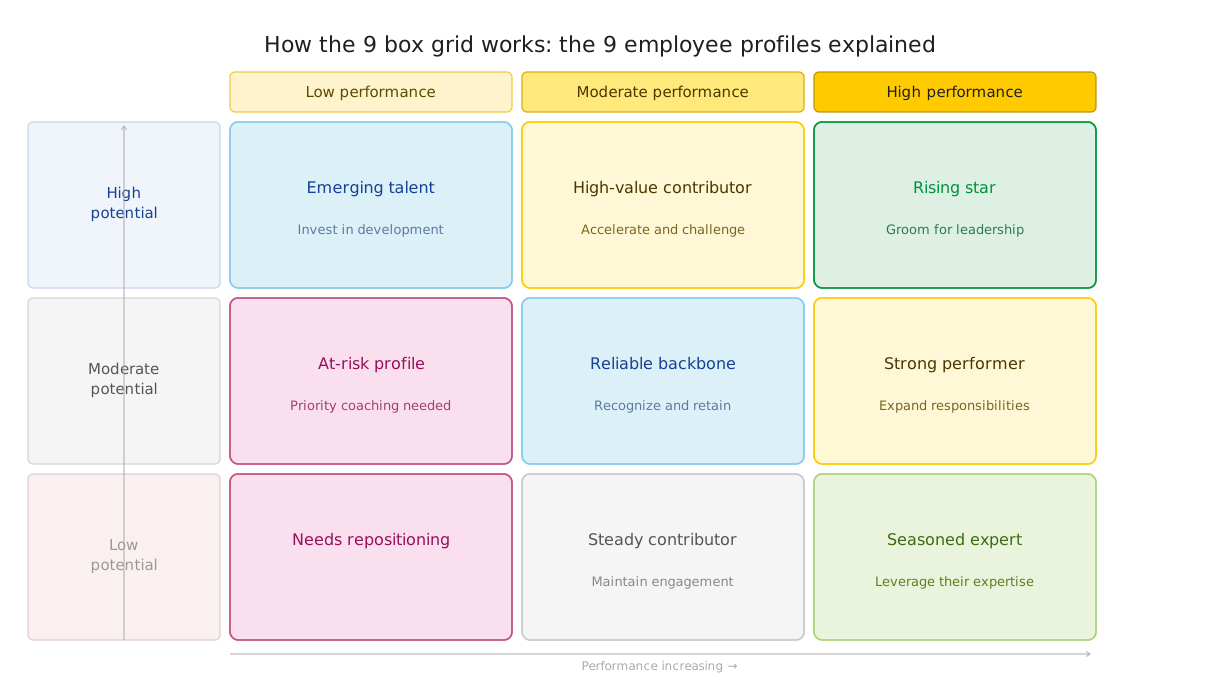
Top right (rising star): High performance + high potential. Your future leaders. Develop and retain as a top priority. Bottom left (needs repositioning): Low performance + low potential. Urgent HR action required. Central diagonal (reliable backbone, seasoned expert): The majority of your workforce. Recognize, stabilize, and keep engaged.
The benefits of the 9 box grid
1. A shared, at-a-glance view of your workforce
The 9 box grid’s greatest strength is its visual simplicity. In a single image, HR and managers get a clear overview of their team’s strengths and development needs, for one department or the entire organization. It’s as much a communication tool as it is an analytical one.
2. More consistent, less biased decisions
By anchoring evaluations to two explicit criteria (performance and potential), the grid reduces the space left for gut-feel or personal impressions. Decisions around promotions, internal mobility, and development plans are grounded in a shared, documented framework.
3. A foundation for succession planning
The 9 box grid sits at the core of most succession planning processes. It makes it easy to identify which employees are ready to step into key roles and which ones need a structured path to get there. This matters especially for small and mid-sized businesses, where losing a key person can have an outsized impact on operations.
4. A tool for engagement and retention
When used thoughtfully, the 9 box grid isn’t just an internal HR exercise. It can fuel meaningful career conversations between managers and employees, clarify expectations, and signal that the organization is investing in people’s growth.
5. Smarter investment in learning and development
Not every employee needs the same development path. The grid helps HR teams personalize L&D plans: accelerated programs for rising stars, targeted coaching for at-risk profiles, stretch assignments for solid contributors who have more to give.
The limitations of the 9 box grid
Here are the main limitations to keep in mind so you can use the 9 box grid effectively.
1. Assessing potential is inherently subjective
Performance is relatively measurable through objectives, KPIs, and review scores. Potential is far harder to evaluate objectively. Two managers can place the same employee in very different boxes. Without clear, shared criteria, the grid can reproduce bias rather than reduce it.
2. The risk of labelling
Being categorized as “needs repositioning” or “low potential” can have lasting effects on how a person is perceived — and how they see themselves. The 9 box grid is a decision-support tool, not a final verdict. It must be used with nuance and treated as confidential.
3. A snapshot by design
The 9 box grid captures a moment in time. It doesn’t account for an employee who is mid-transition, navigating a difficult manager relationship, or going through a major life change. Used only once a year, the picture may already be out of date by the time decisions are made.
4. Only two dimensions
Employees are evaluated on two axes, but people are more complex than that. Engagement levels, specific technical skills, flight risk, or lateral leadership ability… none of these are captured by the standard 9 box model.
5. Zero value without follow-through
The grid is only as good as the actions it generates. Without individualized development plans, career conversations, and regular revisits, it remains an administrative exercise with no real impact.
When to use the 9 box grid
The 9 box grid integrates naturally into several key moments in the HR cycle:
- Performance reviews: The most common use case; you should aim for twice a year or once at minimum.
- Succession planning: Before an anticipated departure or to get ahead of organizational growth.
- Before a promotion or compensation cycle: To ground decisions in a consistent and documented framework.
- After a period of rapid hiring: To get a clear picture of new teams and identify development priorities.
- During a restructuring: To identify the profiles to retain at all costs and those who need support.
How to build and run a 9 box grid in 7 steps
1. Define your evaluation criteria
Before placing anyone on the grid, get alignment on what “performance” and “potential” actually mean in your organization. Performance typically maps to measurable outcomes (goals met, quality of work, deadlines). Potential might include learning agility, adaptability, leadership capability, and openness to new responsibilities.
2. Gather solid performance data
The grid should be built on real evaluation data, not impressions. That means having recent, structured, and documented performance reviews in place. If your organization hasn’t formalized this yet, now is the time to build that foundation.
3. Plot your employees
With your managers, place each employee on the grid in a small, confidential group (HR + direct managers). Challenge outlier placements and watch for consistency across teams : the same standard should apply whether you’re assessing one department or ten.
4. Analyze the distribution
Look at the overall spread. Too many employees in the top-right? Your criteria may be too generous. A cluster in the bottom-left? That often signals a management or hiring issue. A balanced distribution is generally a sign of a credible assessment.
5. Define actions for each box
This is where most organizations drop the ball. For each box, define concrete next steps: a development plan, a targeted training program, a mentorship pairing, a career conversation, a role change, or — when necessary — a performance improvement plan.
6. Communicate thoughtfully
The overall grid stays confidential. But every employee deserves an individual conversation about their strengths, development areas, and the opportunities available to them. The 9 box grid should fuel dialogue, not stay locked in a spreadsheet.
7. Revisit regularly
You should reassess at least twice a year. Situations change: an employee who struggled in one role may thrive with the right support. A top performer can quietly disengage if their growth isn’t being nurtured. The grid is a living document, not a static label.
9-box grid FAQ
What's the difference between performance and potential in the 9 box grid?
Performance measures what an employee is delivering today relative to their goals. Potential assesses their capacity to grow — to take on more responsibility, adapt to new challenges, or move into more complex roles in the future. The two are independent: a top performer may have limited upward potential, and a lower performer may have significant untapped potential with the right support.
How often should you run a 9 box grid assessment?
Ideally twice a year, aligned with your performance review cycles. An annual assessment is the minimum, but it may not capture fast-changing situations. The most mature organizations embed the 9 box grid into quarterly talent conversations.
Is the 9 box grid suitable for small businesses?
Absolutely — and it’s especially valuable for SMBs with 20 to 200 employees, where talent decisions are often made informally. The grid provides a structured framework for conversations that used to happen based on instinct alone, and helps align managers on consistent standards.
How do you reduce bias in a 9 box grid assessment?
Define your performance and potential criteria clearly before the session. Where possible, involve multiple evaluators. Challenge extreme placements — especially when they skew consistently along demographic lines. Train managers to recognize and name their unconscious biases before calibrating.
Should employees know where they fall on the grid?
The grid itself stays internal. What gets shared is a development conversation: what’s expected, where the gaps are, and what the plan is going forward. The box is a starting point for dialogue — not a verdict to be delivered.
Want to go further? Here are additional resources that may be useful to you.
Ressource publiée par