“Empathy, judgment, trust, accountability, even complex problem solving: we need a human element to those things.“
Lindsay Temple, Interim CEO of the Human Resources Professionals Association (HRPA), said this during a recent webinar Folks hosted on the future of HR in the AI era. It’s the kind of line that quiets a room, because it cuts against the usual conversation happening around AI in HR.
Indeed, two postures dominate the AI-in-HR conversation right now: enthusiasm that risks moving too fast, and caution that risks moving too late. Lindsay’s framing offered a third one, and we think it’s the one Canadian HR leaders actually need: AI doesn’t replace the work, but it clarifies which parts of the work were always uniquely human.
Over the course of the conversation, Lindsay, alongside the Folks team, identified the parts of HR that AI cannot do. We pulled five of them together here that are worth holding onto as your organization figures out where AI fits in your HR stack.
1. AI can read the data, but not the room
There’s a moment Lindsay described that stuck with us: she talked about an employee engagement survey that came back glowing. But… something still felt off. And the fix to “this feels off” was not more dashboards, or better prompts. It was a conversation that revealed people just wanted a foosball table and a couch.
2. AI can send a thoughtful message, but it can’t actually be thoughtful
A well-trained AI tool can draft a kind note to an employee going through a hard time, and to be honest, it can sound surprisingly warm. But the moment that note truly matters is the moment the employee opens it. And what do they feel, then? They feel whether someone cared enough to send it or not. The level of perceived empathy doesn’t matter as much as the human behind it.
Lindsay called this out as one of the things that simply can’t be outsourced, and we agree.
3. AI can’t earn trust on your behalf (but it can diminish the trust you’ve built)
HR works hard for the trust it has. You know this. And when AI shows up in a hiring decision or a performance review without explanation, employees notice. Naturally, they start wondering what’s being measured, by whom, and whether they have any recourse.
Lindsay was direct about this in the webinar: if HR isn’t transparent about how AI is used internally and in recruiting, that’s where trust becomes an issue. Trust still has to be built person to person and protected, deliberately, by people.
4. AI can support decisions, but it can’t solve complex human problems
Some HR issues don’t look like problems to solve. If two team members are quietly avoiding each other or someone who used to speak up in every meeting has gone silent, the situation is not about data, but about context. Yes, theoretically, AI can flag the pattern. But it can’t draw on the history built from years of listening, observing, and understanding people in a specific culture. And, most importantly, it can’t hold the discomfort and ask the question that unlocks the real conversation. That responsibility stays human.
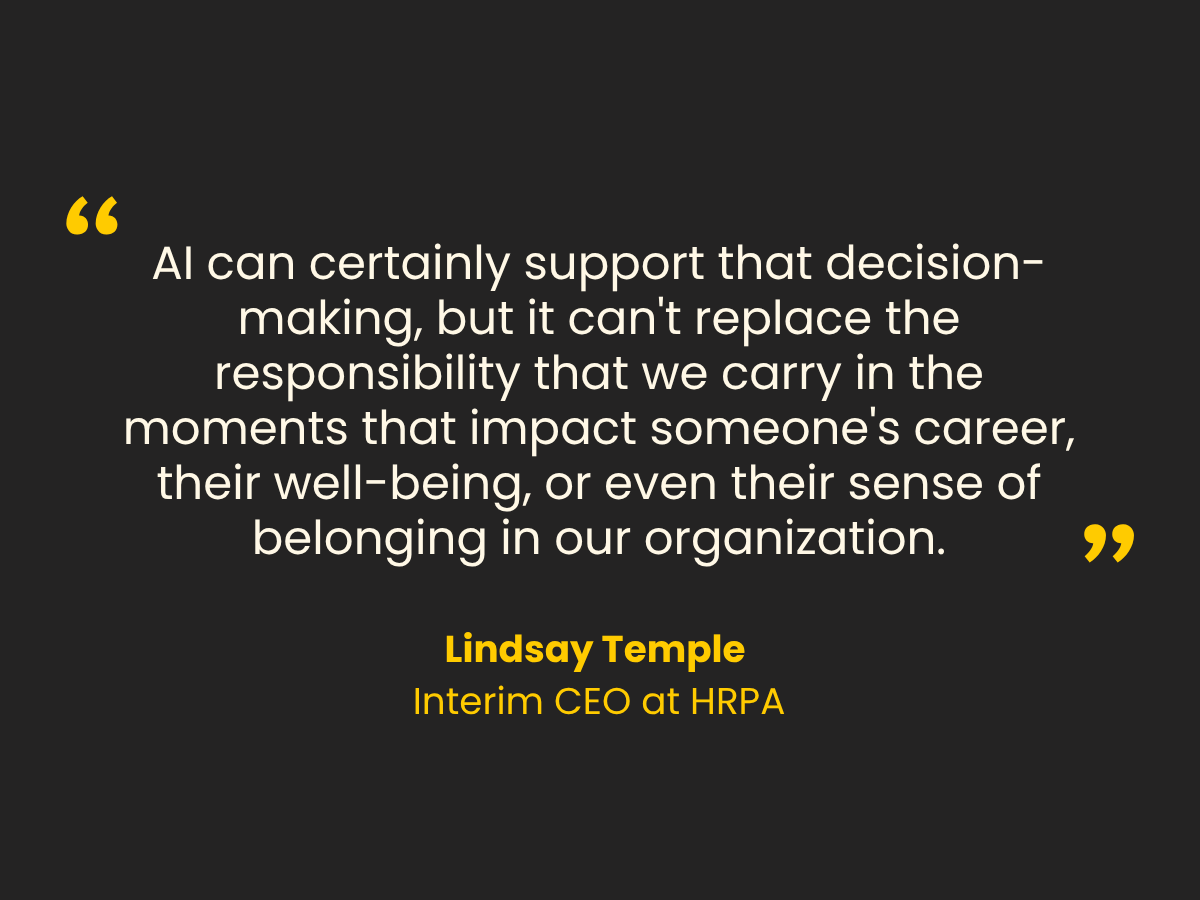
Lindsay was clear: AI supports the thinking, but in the moments that actually matter to people, HR carries the responsibility. Which brings us to the last point.
The lessons? AI can summarize a survey in seconds, but it can’t tell you why the result is misleading. That’s still judgment, and judgment will always remain human.
5. AI can’t be held accountable
When an AI-assisted decision goes wrong (a bad hire, an unfair flag, a process that excluded the wrong person, etc.), someone in the organization has to be answerable. It can’t be an algorithm: it needs to be a human, with a name, who can explain what happened and what changes next. Indeed, if your AI tools are making calls no one can defend, the issue isn’t the AI but the absence of someone willing to stand behind it from a legal, ethical, and operational perspective.
In other words, accountability is one of those things that can’t be delegated to a system, no matter how sophisticated. Lindsay flagged this as core HR territory, and it stays that way.
This list of what AI can’t do is also, indirectly, a list of what HR has to keep doing well
Doing what HR leaders should do requires a strong foundation. Indeed, judgment requires complete data, empathy requires human time, trust requires transparency, complex human problem-solving requires presence, and accountability requires a person whose name is on the decision. Folks builds that foundation for Canadian organizations: bilingual, hosted in Canada, and structured so the human stays at the center of the decisions that matter.
If you’re thinking about where AI fits in your HR stack, and your first step is to build stronger foundations with a Canadian HRIS, we’d love to walk you through how the foundation question shapes everything that comes after.
Resource published by